













Northern Green Anaconda (Eunectes akayima): Scientific Discovery & Taxonomy Report
A detailed scientific report on the discovery of the Northern Green Anaconda (Eunectes akayima), its genetic divergence, indigenous naming, and conservation status.
Scientific Discovery: The Northern Green Anaconda (Eunectes akayima)
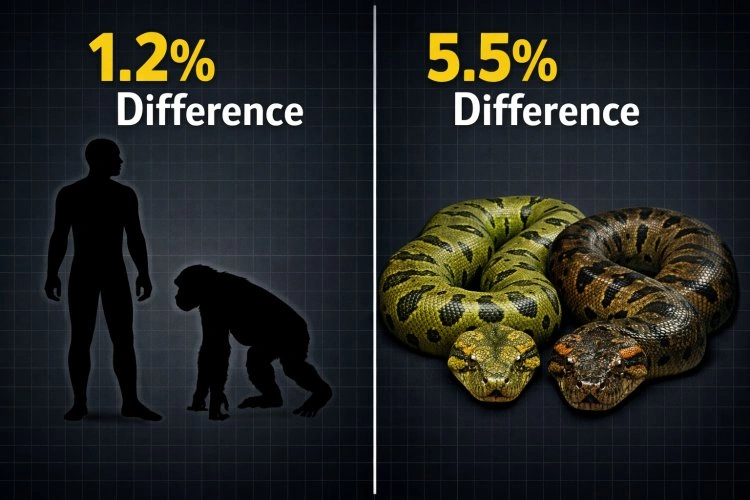
A new giant anaconda species has been officially described in a scientific paper in the journal Diversity, and it is reshaping what we thought we knew about one of the world’s most iconic snakes. Researchers have named this new species the Northern Green Anaconda, or Eunectes akayima, and confirmed that it is genetically distinct from the well-known Southern Green Anaconda, Eunectes murinus.
The study combines DNA analysis, body measurements, and formal taxonomic work to show that what was once treated as a single “green anaconda” is actually two separate species with different evolutionary histories and conservation needs.

Researchers have revealed deep genetic and ecological differences in the new species.
A New Species Emerges: The Study Details
The description of Eunectes akayima was published in the open-access journal Diversity in 2024. In this work, scientists formally separate the northern populations of green anacondas from the classic southern species. The paper focuses on populations living in the Orinoco Basin and adjacent regions, including parts of Colombia, Venezuela, Guyana, Suriname, French Guiana, northern Brazil, Ecuador, and Peru.
For many years, herpetologists suspected that green anacondas might represent more than one species. Previous genetic work hinted at deep splits, but this new study integrates genetics, morphology, and formal taxonomic decisions into a single, detailed dataset.
? How Researchers Proved the Distinction
The paper uses multiple independent approaches to support the recognition of Eunectes akayima:
- Mitochondrial DNA Analysis: Researchers quantified the genetic distance, finding divergence levels consistent with distinct species.
- Morphological Data: A massive dataset of over 1,400 anacondas was examined for traits like body length and head proportions.
- Evolutionary Timing: Using molecular clock analysis, they estimated the split from a common ancestor occurred roughly 10 million years ago.
Taxonomy and Indigenous Naming
The authors meticulously applied the International Code of Zoological Nomenclature (ICZN) rules to stabilize the group's naming. They formally described the Northern Green Anaconda as Eunectes akayima sp. nov. while retaining Eunectes murinus for the Southern species.
The name “akayima” holds cultural significance. The authors explicitly state they drew the name from Indigenous languages to honor Indigenous nations and their connection to the land. This approach challenges historical Eurocentric traditions in zoology, making taxonomy more inclusive.
Sexual Size Dimorphism (SSD)
Green anacondas are famous for extreme sexual size dimorphism, where females are significantly larger than males. The study shows that the degree and pattern of these size differences are not identical between the two species. This has major implications for understanding reproductive biology, mating ball formations, and habitat usage.
Note on Scientific Debate: Like many major taxonomic revisions, this recognition has faced some skepticism regarding the interpretation of yellow anaconda forms. However, the Diversity paper stands on robust, long-term fieldwork and large sample sizes.
Conservation Urgency
One of the most critical takeaways is the impact on conservation. When treated as a single widespread species, green anacondas appeared secure. However, splitting them reveals that the Northern Green Anaconda has a smaller, more restricted distribution.
This makes Eunectes akayima more vulnerable to:
- Habitat loss and deforestation.
- River modification and oil extraction.
- Human impacts in the Orinoco and Amazon regions.
Recognizing this species forces conservation planners to reassess protection priorities. Taxonomy directly influences how resources are allocated to protect biodiversity in the world’s largest tropical rainforest.
? References & Sources
- ? Rivas et al., 2024, Diversity: Description of the Northern Green Anaconda (Eunectes akayima sp. nov.) - View Paper
- ? National Geographic: Scientists reveal new green anaconda species - Read Article
- ? Mongabay: New giant anaconda species found on Waorani Indigenous land - Read Report
- ? VU Amsterdam: Revealing a New Green Species and Rethinking Yellows.
What's Your Reaction?
 Like
0
Like
0
 Dislike
0
Dislike
0
 Love
0
Love
0
 Funny
0
Funny
0
 Angry
0
Angry
0
 Sad
0
Sad
0
 Wow
0
Wow
0